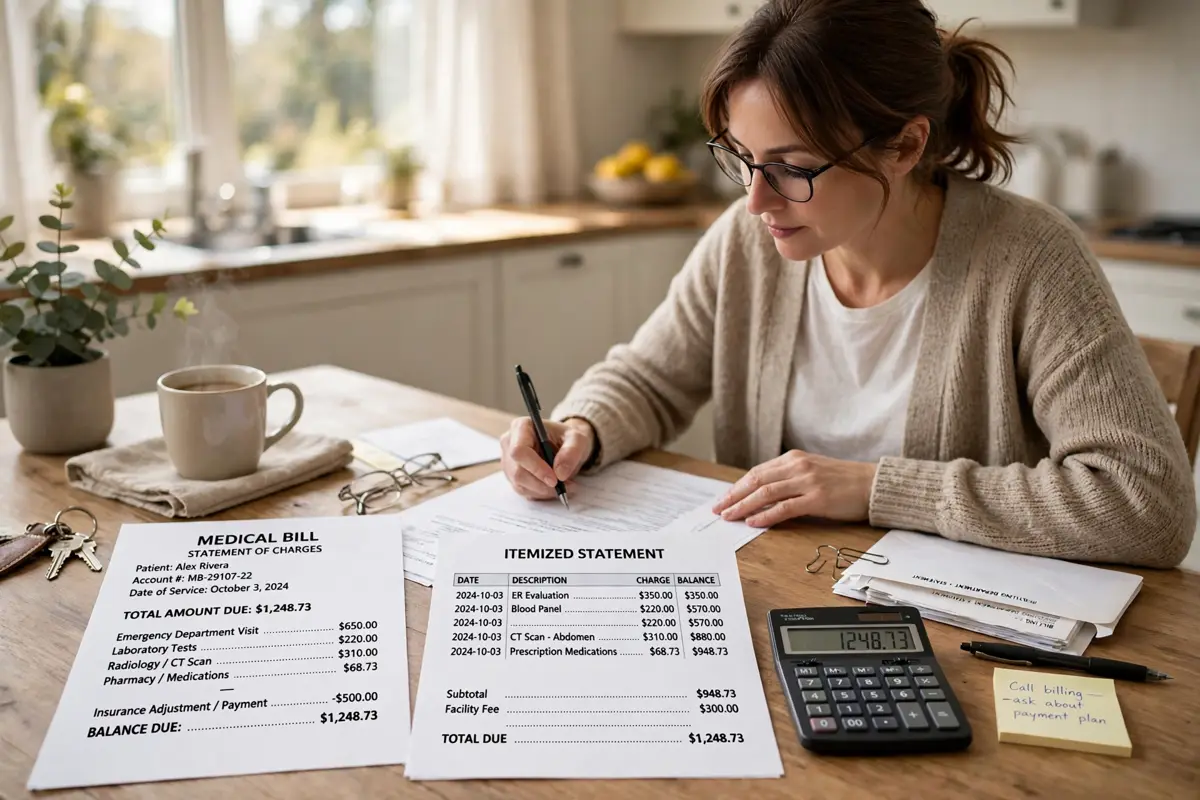

Opening a medical bill can sting twice, once for the treatment and once for the total. Mistakes on medical bills are common, though, and most billing offices expect patients to question charges. If you learn how to dispute a medical bill calmly and in the right order, you stand a fair chance of paying only what you truly owe.
This guide takes you through the process step by step, from the first envelope to a written agreement. You do not need legal training. You need the itemised statement, a notebook, and a little patience.
Start by Asking for an Itemised Bill
The summary bill that arrives first rarely shows enough detail to check anything. Call the billing office and ask for an itemised statement that lists every charge with its date and code. Most providers send this free of charge, and many patient portals let you download it directly.
While you wait, gather your own records. Appointment letters, discharge papers and your insurer’s explanation of benefits all help you compare what happened with what was charged. If the bill involves insurance, our guide to choosing travel insurance explains how cover, exclusions and excess payments work, and the same ideas apply when you check a health policy.
Check the Statement Line by Line
Sit down with the itemised bill and a pen. Billing errors follow patterns, and most people find at least one when they look closely.
- Duplicate charges for the same test, scan or consultation.
- Services dated on days you were not at the facility.
- A procedure billed at a higher level than the one you received, known as upcoding.
- Charges for medicines or supplies that were cancelled or never used.
- Your name, insurance details or policy number typed incorrectly, which can push a covered bill onto you.
Circle anything that looks wrong and write a short note beside it while the visit is still fresh in your mind. Memory fades fast, and clear notes make the next step much easier.
It also helps to compare the statement with your insurer’s explanation of benefits. If the insurer says a service was covered, the provider should not bill you for it again beyond any agreed excess or copay. Mismatches between the two documents are one of the most common sources of inflated bills, and one of the easiest to prove.
Call the Billing Office and Take Notes
Ring the billing office on a weekday morning, when queues are shortest. Be polite, explain that you are checking the statement before paying, and ask the agent to walk through each circled item. Many simple errors are corrected on that first call.
Write down the date, the name of the person you spoke to, and what they promised. If they agree to remove a charge, ask for the corrected total and when a revised bill will arrive. A dispute handled by phone still deserves a paper trail.
If the first agent cannot help, ask politely for a supervisor or a patient advocate. Large hospitals employ advocates whose whole job is to untangle billing problems, and they can often approve corrections that front line staff cannot. Note the advocate’s name and direct number for any follow up.
The process can feel stressful, especially when money is tight. Short pauses help more than people expect, and our beginner’s guide to meditation offers a simple way to steady yourself before a difficult call.
Put Your Dispute in Writing
If the call does not resolve things, send a written dispute by email or tracked post. Keep it short and factual. State your account number, list each charge you dispute with the reason, and attach copies of your supporting records. Never send originals.
Ask the office to pause collection activity while the dispute is reviewed, and to confirm receipt in writing. In many places a written dispute also protects you if the bill is later passed to a collection agency, because the timeline shows you raised the problem promptly and reasonably.
One reader in Ohio followed exactly this pattern after being billed twice for the same scan. Her letter, two pages with the duplicate lines highlighted, brought a corrected bill within three weeks and saved her a little over 400 dollars. No lawyer, no drama, just clear paperwork.
Ask About Reductions and Payment Plans
Even when a bill is accurate, the amount is often negotiable. Hospitals and clinics frequently offer prompt payment discounts, hardship reductions or interest free instalments, but they rarely advertise them. Ask directly what options exist for paying in full today, and what plan they can offer if you cannot.
Timing helps too. Billing departments often work to monthly targets for closing accounts, so a calm call with a realistic offer to settle can land well. Never promise an amount you cannot pay, though. A broken agreement is harder to renegotiate than a bill that was never agreed in the first place.
Get any agreement in writing before you pay a cent. The letter or email should state the agreed total, the instalment amounts and the dates, so nobody can revive the old figure later. Keep it with your other records until the balance shows as settled.
If the Bill Goes to Collections
A disputed bill that still lands with a collection agency is not the end of the road. Write to the agency within the window stated on their letter and ask them to verify the debt. Send a copy of your earlier dispute so they can see the charge was already under review.
Keep paying undisputed amounts on time, and keep every letter. Calm records beat strong words in almost every billing disagreement, because the person reviewing your file can only work with what is in front of them.
More Guides for a Calmer Household
Money worries rarely stay at the kitchen table, so look after the basics while you sort the paperwork. Our guide to sleeping better with simple habits helps when your mind races at night, and our practical wellness guide covers steady routines for body and mind. Readers also rate our tips to recharge your body and mind and our advice on starting a morning routine that sticks for getting life back on an even keel.
The Takeaway on Billing Disputes
To dispute a medical bill well, ask for the itemised statement, check every line, make the call, then put your case in writing. Most errors are honest mistakes, and billing offices fix them when the evidence is clear. Take it one step at a time, keep your notes, and pay only the corrected total.