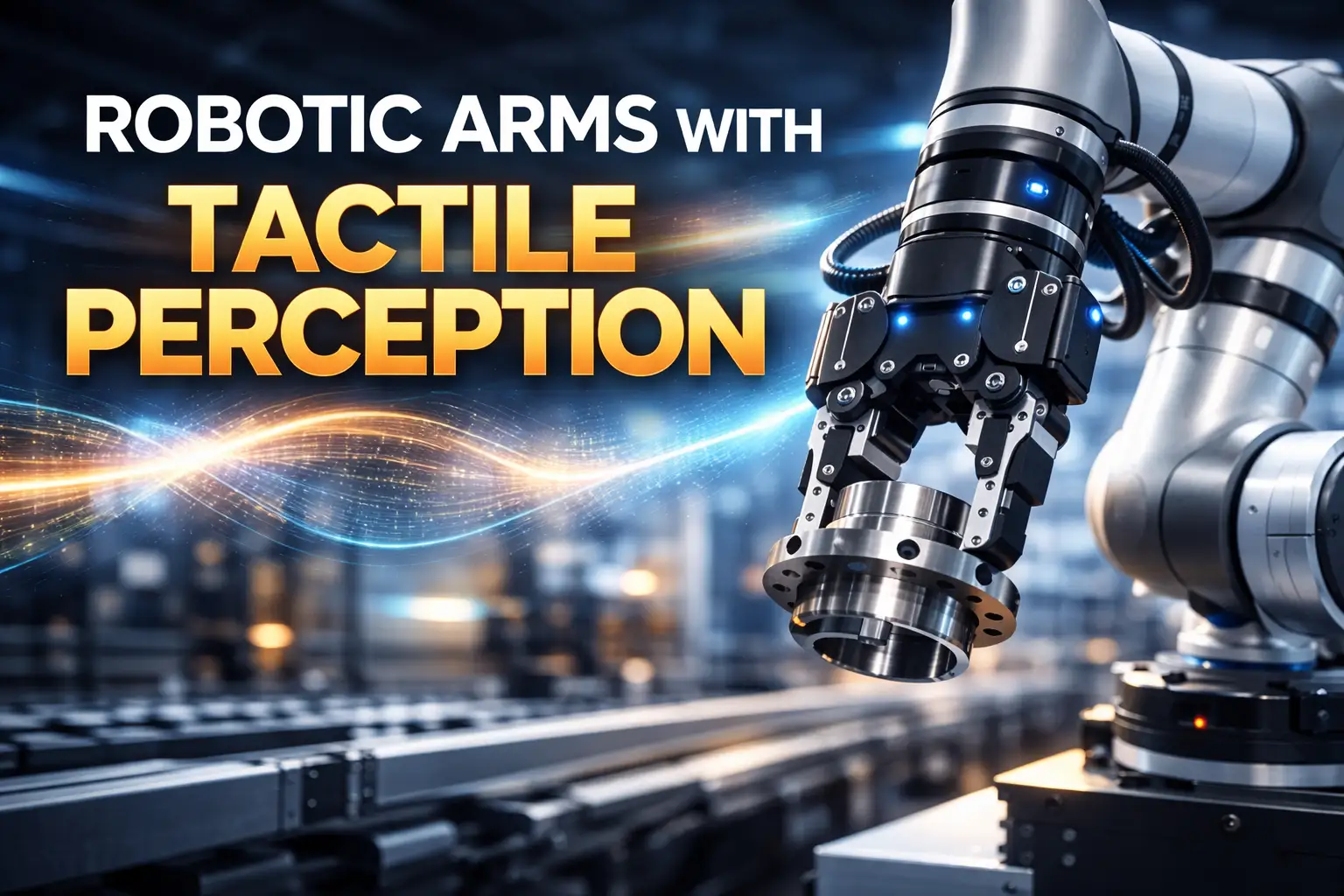

In the early chapters of industrial history, robotic arms were essentially blind powerhouses. They were programmed to move to specific coordinates with absolute rigidity, executing repetitive tasks with terrifying speed but zero awareness of their surroundings. If a part was slightly misaligned or a human hand inadvertently entered the work envelope, the machine continued its pre-programmed path regardless of the resistance encountered.
Today, we are witnessing a fundamental shift. The integration of advanced haptic technology and force/torque sensors has transformed the “dumb” actuator into a sensitive instrument. This evolution is narrowing the gap between mechanical output and the nuanced dexterity of the human hand, allowing robots to “feel” their way through complex environments.
The Limitation of Coordinate-Based Automation
Traditional automation relies on spatial precision. A robot is told to move to a point defined by $(X, Y, Z)$ coordinates. While this works perfectly for heavy lifting or spot welding in a fixed environment, it fails in scenarios where the workpiece is inconsistent. If a casting varies by a few millimeters or a component is fragile, a rigid coordinate-based system often results in mechanical stress or broken parts.
The introduction of Force/Torque (F/T) sensors changes the primary feedback loop. Instead of only checking where the arm is, the system constantly monitors how much resistance it is meeting. This allows the robot to adapt its path in real-time. If a robot is tasked with inserting a pin into a hole, it no longer just pushes; it “searches” for the opening by feeling the edges, much like a human would in low-light conditions.
Mastering the Delicate Touch of Electronics Assembly
The assembly of printed circuit boards (PCBs) and sensitive electronic components has long been a challenge for automation. The forces required to seat a connector are minute, and the margin for error is non-existent. Excessive pressure can micro-fracture a board, leading to latent failures that are expensive to diagnose.
By utilizing high-resolution sensors, modern robotic systems can maintain a constant, pre-defined force. This tactile sensitivity allows for the automation of delicate tasks such as picking up silicon wafers, plugging in ribbon cables, or testing the “click” feedback of buttons. The robot provides a level of consistency that exceeds human capability because it does not suffer from fatigue or the subtle tremors that affect manual precision over an eight-hour shift.
Surface Finishing and the Challenge of Curved Geometry
One of the most significant breakthroughs in sensory-driven robotics is in the field of surface finishing—sanding, buffing, and polishing. These tasks are notoriously difficult to automate because they require the tool to follow complex, non-linear geometries while maintaining a perfectly uniform pressure.
A robot operating without tactile feedback would either lift off the surface on a curve or dig too deep into a contour. However, Onrobot collaborative robots equipped with integrated force/torque sensors can “trace” the surface of a car door or a wooden furniture component. The sensor detects the slightest change in resistance and adjusts the arm’s position instantaneously to keep the finishing tool at the optimal pressure. This results in a uniform finish across the entire part, regardless of its shape.
Safety Through Sensory Awareness
The transition from traditional industrial robots to collaborative environments is rooted in safety. When a robot is capable of feeling contact, the nature of the workspace changes. In a collaborative setup, the robot acts as a partner rather than a hazard.
If a robot equipped with advanced haptic sensors makes contact with an unexpected object—such as a worker’s arm—the spike in force is detected in milliseconds. This triggers an immediate category-0 stop, preventing injury. This “touch-stop” capability removes the need for physical barriers and cages, allowing for a more fluid and space-efficient factory floor. It turns the robot into an extension of the worker’s own capabilities, capable of handling the heavy or repetitive aspects of a job while remaining safe to be around.
Reaching for Human Manual Dexterity
We are approaching a point where the distinction between “manual” and “automated” is becoming a matter of software rather than physical capability. While a human hand remains a marvel of biological engineering with thousands of nerve endings, modern robotic sensors are catching up in terms of functional precision.
The ability to measure force in all six axes—three for force and three for torque—gives a robot a comprehensive understanding of the physical stresses acting upon it. This data is not just used for movement; it is used for quality control. A robot can now “know” if a part is out of spec simply by the way it feels during a grip or an assembly step.
As these sensors become more integrated and the software more intuitive, the complexity of deploying such systems continues to drop. For the production manager or automation engineer, this means that the most difficult, “human-only” tasks on the assembly line are now viable candidates for automation. The evolution of robotic touch is not just about making machines better; it is about making them more capable of interacting with a variable, physical world with the same intuition we once thought was uniquely human.